Browse > Home /

| Subcribe via RSS


Government priorities gone bananas

By Angela Harbutt
January 13th, 2012 at 10:54 am | No Comments | Posted in Government

I was reading Professor Philip Booth’s excellent blog post yesterday on David Cameron’s red tape challenge to ministers. Here is an extract that caught my eye.. (emphasis is mine) .

Of course, this is just what we need – more employment regulation. It comes in a long line of announcements and enactments over the last two weeks about executive pay, council house tenancies, the disastrous implementation of the moratorium on employment regulation for small firms, alcohol regulation, the extension of employment rights to temporary workers and the regulation of the scrap metal industry. I am wondering if I have misunderstood the government’s red tape challenge – is the challenge to ministers to produce as much red tape as possible?

And I found myself cheering his point that..

“If somebody is not very clever but good at building networks, why should they be looked down upon more than somebody who is clever but not good at building networks? The hard work that one puts into networking is not obviously less virtuous than the hard work that one puts into developing one’s intelligence. The good luck that comes from being born with a good brain is no more virtuous (indeed it is not virtuous at all) than the good luck that comes from being born with a set of well-networked parents.”

But that is perhaps because I was not a particularly brilliant scholar but had “the gift of the gab” (though sadly no “connections”). Goodness only knows what job I would have ended up with if my application had gone in “blind” rather than me tracking potential bosses down to seedy pubs to pester them into giving me an interview.

Professor Booth’s point is not that dissimilar to a point I made recently. Why is it that Government seems happy to go after highly paid bankers and CEOs on such issues as bonus’/ pay differentials etc whilst ignoring the vast sums earned by Premier League Footballers, pop stars and the like?  After all the pay differential between the average Manchester United fan and their top players is vast – and the penalty for failure? they get transferred to another team quite often for even more money. Why is it, I wonder, that it’s OK to earn fortunes because you are good at kicking a ball about – but not if you happen to be masterful at running a company? (Note this is NOT a demand that the Government starts meddling in sports pay as well.)

But returning to David Cameron’s challenge – maybe it is time for him to reconsider giving a wider challenge to ministers and put it in really simple terms – since they do seem to be having trouble grasping the point.

“If it doesn’t cut costs, improve effeciency or help business get the economy going, then JUST DON’T DO IT – unless there is a bloody good reason why you have to – Dave”

I know ministers like their headlines, feel the need to be seen to be doing something, but really! Most of us are sitting in our homes wondering what the hell this government is up to? What we want are jobs, an economy that gets going, the clearing of our debts. What on earth has alcohol regulation or executive pay got to do with any of those things?

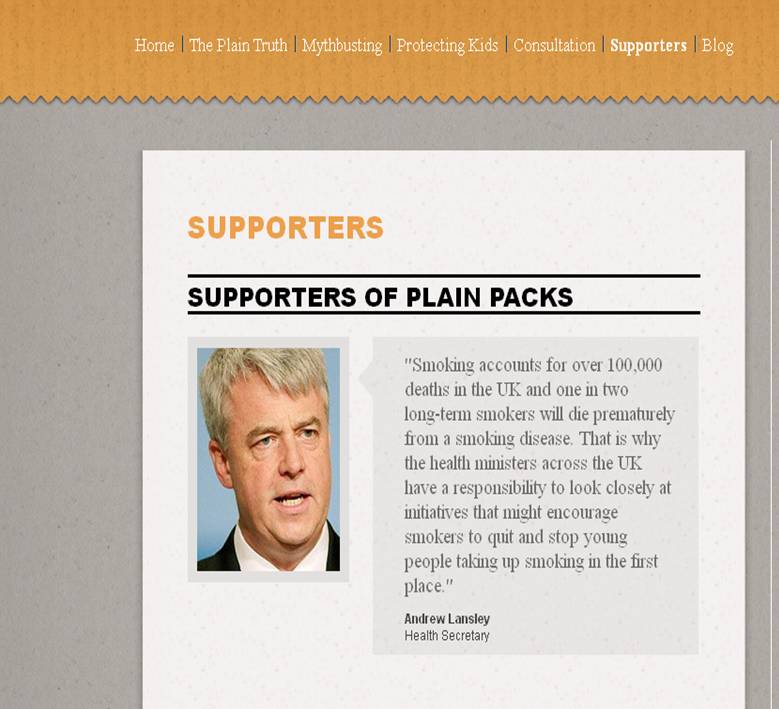
Mark Littlewood has been asked by the Government to help them on red tape. Perhaps the Government needs a similar expert to help them sort out Government priorities – ( I say “expert” all we need is a person with an ounce of common sense and a large red pen). Here is one example concerning my current hobby horse. Why is Andrew Lansley devoting vast amounts of time, money and resource undertaking a consultation on tobacco plain packaging, when we can sit back for six months and wait for the REAL evidence to come from Australia (where plain packaging is about to be introduced). With the time and resource released he could devote that to sorting out the current crisis in the NHS now- and return to plain packs if/when the evidence from down under suggests that it warrants it. It’s just about priorities. Surely?

Enjoy Professor Booth’s musings – definitely worth a read.

Tags: , , , , ,

Health Secretary shows dash of common sense shock!

By Editor
December 20th, 2011 at 10:00 am | No Comments | Posted in health, Nannying, Nudge Dredd

Common sense from Lib Dem Members… now common sense from the Health Secretary… What is the world coming to? A beady-eyed reader of the Independent On Sunday brings us word that the Health Secretary has come out loud and proud stating that minimum pricing on alcohol  is not the answer. Some of you will have noticed last week that a group of leading doctors and academics were publicly calling  for the Government to bring in a minimum price on our drinks. But this has apparently failed to impress Mr Lansley!

Talking about the impact of minimum pricing, Lansley said whilst higher prices for drink can reduce consumption “It is more likely to have a bigger proportionate impact on responsible drinkers who happen to be low-income households“. Yes sir. Exactly right. Why penalise the responsible hard-up drinkers for the actions of the irresponsible minority. But wait.. there’s more……He also is quoted as saying….

Are we really saying that because a bottle of vodka isn’t £8 but £12.50 they are not going to preload with a bottle of vodka for a night out when they are in clubs where they pay £5 for a drink? That is absurd. They are still going to do this binge drinking because that is a behaviour issue. We have got to do much more to focus on what this means.

Of course this does not per se mean that the Coalition has finally embraced it’s much-flaunted “liberal-self”. We do still await next years “alcohol strategy” – though quite what any Government thinks it is doing having an “alcohol strategy” is beyond us.

And who knows what the academics will come up with next to justify their tax-funded jobs.. I guess we can depend on them not to give up that easily.

After all, it was way back in 2003 that the British Medical Association first proposed levying a 17.5 per cent fat tax on high-fat foods. It was rejected back then on the grounds that the population would reject a ‘nanny state’. (Those were the days) . And whilst Public Health Minister Melanie Johnson has gone on the record recently saying that a fat tax is “not likely”  – the sheer pressure being applied by health lobby groups means that there remains the distinct possibility that tighter restrictions on advertising and promotion of food and drink will be introduced.

But that is for another day. Today we applaud the Health Secretary for NOT automatically reaching for the legislative route just because the academics demand it – recognising the complexity of the issues involved and, perhaps, the danger of unintended consequences of Government intervention.

Tags: , ,

What hope is there for liberty if truth becomes a plaything of militant lobbyists?

By Guest
November 29th, 2011 at 10:26 am | 4 Comments | Posted in Government, health, Spin

Tobacco was unfortunately very much in the news again recently with the BMA launching a campaign to ban smoking in cars probably as a prelude to what will then seem a more reasonable move to get it banned when children are present. I want to focus here not on the ban but on the methods being used by its advocates.

On Radio 4s Today programme Vivienne Nathanson of the BMA was questioned about her evidence:

Nathanson: Well, the evidence is, in fact, that the levels of toxins that can build up in a car do reach 23 times the levels in a smoky bar…

Interviewer: And that is—sorry to interrupt you—but that is peer-reviewed?

Nathanson: Yes, absolutely.

Interviewer: Everyone in the scientific community accepts that it’s true?

Nathanson: Absolutely.

The BMA has since issued a major correction and apology with the explanation that the mistake was caused by human error.  These things happen but as Head of Science and Ethics, Nathanson has a duty to check. I find her glib assertions regarding peer review and scientific consensus indefensible. It is hard to see how they could be made in error.

The same day over on Radio 5, a phone in caller queried the general evidence base for passive smoke harm and Deborah Arnott of ASH countered by emphasizing claims that heart attacks have been reduced by smoking bans:

“There’s very good evidence supported by the BMA, the Royal College of Physicians, the World Health Organisation, the Standing Committee on Tobacco & Health which reported to the Department of Health. The Coalition Government very recently conducted a review of smokefree legislation, and what we’ve seen is a significant decline in heart attacks following the implementation of the legislation. The evidence is incontrovertible.”

In response to criticism that a fall in heart attacks in England post the 2006 Health Act was part of an existing trend, she said:

“Yes, but the decline is greater than trend. And that’s in a peer-reviewed article published in a very reputable journal, and it’s been found not just in England, Scotland, but everywhere that smokefree legislation in public places has been brought in.”

The statistics on heart attack hospital admissions in the UK are freely available to all on line. Here is a link to the NHS data for Scotland.

Using the measure preferred by the tobacco control industry and the hospital admissions data from NHS statisticians (table AC5) we can calculate emergency admissions for heart attacks as follows:

12 months pre ban:             7905
0-12 months post ban:        7250        (-8.29%)
12-24 months post ban:      8913        (+12.75%)
24-36 months post ban:      7707        (-2.50%)

() = % change from pre ban baseline

The word Arnott used was incontrovertible, the claim is a 17% reduction and the intervention was presented by some supporters as certain to have an immediate major impact on public health. Taking all that into account we should see a consistent, trend independent effect in the public record but whichever table or measure we use it is impossible to objectively claim that such an effect exists.

I value sober analysis of NHS statistics more than I do articles authored by tobacco control activists, peer reviewed or otherwise. I am not alone in this view and it is unlikely that Arnott is unaware of the serious credibility issues facing all the studies that support her claim or indeed of the existence of other work that contradicts it. The evidence is very far from incontrovertible.

Arnott is a skilled professional propagandist who is all too aware that, whatever the actual truth; provided that she sounds convincing her version will be believed by enough otherwise ill-informed people to achieve her objective. An article here gives some insight into her personality and the nature of her campaign.

Arnott is correct in saying that there has been a peer reviewed publication in the BMJ that supports her claim.  It claims a 2.4% decrease in heart attacks due to the ban but fails to adequately explain how the result was arrived at. This approach is sadly increasingly common in medical journals. Bearing in mind Arnott’s comment on trends, it is notable that, according to the NHS, the overall decline in heart attacks for the 12 months post ban was 4.26% compared to a 5.19% decline 2 years before the ban. The post ban decline was in fact neither large nor significant. The BMJ paper was produced by a team led by Anna Gilmore.

Arnott is also correct in saying that there has been a review of the 2006 Health Act. It was written by Linda Bauld.

The authorship of both these papers throws up some very searching questions about ethics at the Department of Health. Surely in a society that allegedly values honesty and transparency we have a right to expect government to review policy and measure its efficacy using the most qualified, objective and unimpeachable resources available. Why then did the DH directly commission two not especially qualified people both of whom have a notable history of anti-tobacco activism? The results were hardly likely to be seen as either credible or objective.

ASH is largely funded by the Department of Health and appears to be in firm control of the government’s agenda.

How can we possibly have a free and liberal society if we allow the truth to become the property of pressure groups directly funded by government departments?  The principles at stake here radiate way beyond tobacco. We urgently need to reform the charity sector and I would suggest also the Department of Health.

Thanks to Chris Snowdon and Frank Davis for giving their time to transcribe the radio interviews.

Written by Chris Oakley.

Tags: , , , , , , ,

Australia’s new plain packaging law for cigarettes may have got Andrew Lansley off the hook

By Editor
November 21st, 2011 at 8:48 pm | 1 Comment | Posted in freedom, Government, health, Nannying, Nudge Dredd


HAT TIP : Mark Littlewood (formerly of this parish) has posted an interesting article over on the Daily Mail today. It concerns tobacco plain packaging – but considers it from an angle we’ve not seen elsewhere. In it he suggests that the Australian government may have got Andrew Lansley at the Department of Health off the hook. How ?

“Well, he is a Cabinet minister in a government which claims to support deregulation….Fortunately, the Health Secretary does not need to marshal a whole series of arguments to rebut the case for plain packaging of tobacco (which would, in any event, be quite hard to do – as it is difficult to rebut a case based on no credible evidence whatsoever). He can cancel his promised consultation on the subject (originally anticipated to be launched in the next few weeks), thereby saving everybody a lot of time and effort. He can then sit back and wait for a couple of years and see what independent evidence suggests the impact to be in Australia, if the legal challenge from tobacco companies fails to reverse this intrusion into free expression.”

Click on the link above to read the whole article. It’s an interesting thought. Just how committed is this government to deregulation?

Tags: , , , ,

Battle lines are drawn: this is the mother of all fights

By Angela Harbutt
November 10th, 2011 at 10:44 pm | 12 Comments | Posted in Economics, Nannying, Personal Freedom

A huge chunk of the corporate world will be taking a very sharp intake of breath right now as it is announced that Australia is to become the first country to seek to strip private legal companies of their trademarks. 

The Australian government has today effectively passed a bill that will mean from December next year, all cigarettes will be sold in olive green packs, with no trademark brand logos permitted on any packaging. Companies will be able to print their name and the cigarette brand in small, prescribed font on the packets together with stark health warning messages and pictures, which will cover 75% of the front of the pack and 90% of the back.

Tobacco companies have vowed to fight the new legislation in court. And rightly so. Can you imagine Coca Cola allowing the shiny red can and swirly brand name to be removed and replaced by an olive green can, with warnings of addiction and early death plastered all over it, without challenge? Or Cadbury giving up its purple bars of loveliness, or Tanqueray its distinctive green bottles without a fight? No I don’t think so. They would rightly argue that their branding is about product differentiation and brand share, that they have invested millions in their trademarks and will challenge any body – including governments – that seek to take that away.

And whilst once the fast food, confectionery and drinks industry stood as far away from the tobacco industry as they possibly could (with fingers crossed muttering quietly “please not us next, please not us next”). “The times they are a changin”.

Taxation, the original weapon of choice of Governments seeking to discourage tobacco consumption, returns increasingly to the alcohol industry, and  is now the insidious stick with which to beat the food industry (think Danish fat tax).

Nor will it stop at just tax. Where health lobby groups have succeeded with tobacco – so they will follow for alcohol, fast food, chocolate and every other indulgence we enjoy.    We already see that great old anti-smoking chestnut- the cost to the NHS -appearing with increasing frequency …  “the cost of obesity to NHS“  or the “£3bn cost of alocohol to NHS every year” .

So too have the scare tactics – the headlines that  get ever more hysterical … the “obesity pandemic“… “Fatty foods Addictive like Cocaine“… “Binge drinking on the rise” (never mind that according to the governments own statistics, alcohol consumption is actually falling).

We are already see signs of anti-tobacco-style attacks on food distribution ( health lobby groups arguing for a ban on siting of “fast food outlets” near educational facilities) and advertising (Diane Abbott’s criticism of Coca Cola and McDonalds sponsoring the Olympic Games) etc.

So sure as night follows day  it’s only a matter of time before it will become “widely accepted” that many of our pleasures and indulgences are in fact wicked evil addictive substances and that we are not responsible consumers but the” hapless and the exploited” that need protecting for our own sakes.

It’s a tiny step from there to the decision that it’s the branding of the fizzy drink, bottle of booze, bar of chocolate, or burger that’s the problem – and stripping away the trademark, packaging design and strap line – is not just desirable but necessary.

And whereas now we have politicians stating “If this legislation stops one young (Australian) from picking up a shiny, coloured packet and prevents them becoming addicted to cigarettes then in my view it will have been worthwhile,” we we soon hear them saying this instead…

If this legislation stops one young (Australian) from picking up a shiny, red tin of Coca Cola  and prevents them becoming addicted to fizzy drinks then in my view it will have been worthwhile” .

And the consequences of travelling blindly down this health evangelist’s path will be brands competing on price, not quality, not health; a duller, less imaginative and exciting world; counterfeiting criminal gangs having a field day; and we the people accepting that we know nothing about anything and that “Government knows best”. When we all have Soviet style cola rationed to us by our “benign” governments we can all praise them and thank them for saving us from ourselves.

I am sure that we all ate more vegetables in the Middle Ages -and probably in Soviet Russia too-  they are just not ages I want to return to, nor regimes I wish to live under. There is an alternative. We can say NO MORE. This is a line in the that has been crossed…Companies have rights. People’s pensions and life-savings are tied up in these companies and their brands. Trademarks can’t be dismissed on a whim.  Intellectual Property Rights can’t be casually cast aside.  And perhaps most importantly …We are adults – not children. And we whilst we say yes to informed choice, education, and help to those who want it…we say no state control.

THIS is a battle that we cannot allow tobacco to lose.

Tags: , , , , , , ,